Leap Seconds Are Ending: UTC Goes Continuous in 2027
No more 61-second minutes. From 20 May 2027 the world's official time stops inserting leap seconds. Here is what a leap second actually was, and why getting rid of it is harder than it sounds.
18 October 2026 · 9 min read · Science
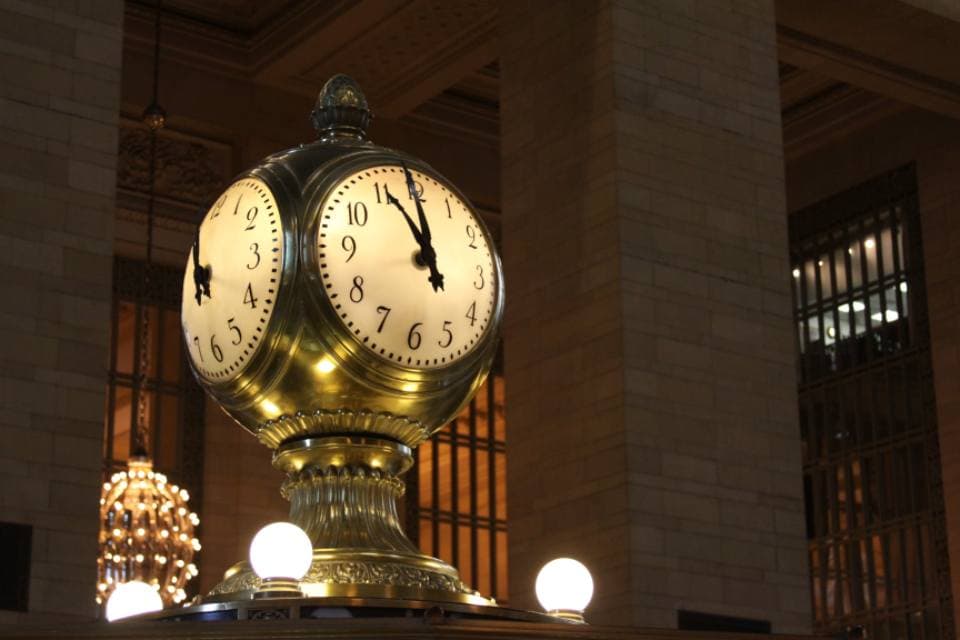
On 15 October 2026, at its meeting in Versailles, the General Conference on Weights and Measures (CGPM) voted to make Coordinated Universal Time continuous. From 20 May 2027 — World Metrology Day — no more leap seconds will be added. It is the largest change to civil timekeeping since the leap second was introduced in 1972.
This guide explains what a leap second actually is, why a single second caused so much trouble, and what "continuous UTC" means for anyone who keeps time on a computer. For the wider meeting — the budget, the lunar time scale and the roadmap to an optical second — see our guide to the 28th CGPM. Here we stay on the leap second itself.
Three kinds of time
To see what changed, you need three separate time scales.
- UT1 is astronomical time. It tracks the actual rotation of the Earth, measured against distant quasars. It is, loosely, what the Sun says.
- TAI, International Atomic Time, is the steady count of seconds kept by the world's atomic clocks. It never skips, stretches or pauses.
- UTC, Coordinated Universal Time, is the compromise that everybody's clock actually shows. It ticks at the atomic rate of TAI, but it is nudged to stay close to UT1.
The Earth is not a good clock. Tides, the sloshing of its molten core and the movement of ice and water all change its spin by fractions of a millisecond a day. Over months those fractions add up, and UT1 drifts away from atomic time. The leap second was the patch that held the two together.
What a leap second is
Whenever UTC was about to drift more than 0.9 seconds from UT1, the International Earth Rotation and Reference Systems Service (IERS) in Paris ordered an extra second inserted. The clock read 23:59:60 for one tick before rolling over to 00:00:00. Announcements came roughly six months ahead, in the IERS publication known as Bulletin C.
Since the scheme began in 1972, 27 leap seconds have been added, every one of them positive — adding a second, never removing one. The most recent was inserted on 31 December 2016. Together with a fixed 10-second offset agreed in 1972, those 27 steps mean that atomic time now runs exactly 37 seconds ahead of UTC.
| Fact | Value |
|---|---|
| Leap seconds introduced | 1972 |
| Most recent leap second | 31 December 2016 |
| Total added, all positive | 27 |
| TAI − UTC today | 37 seconds |
| Tolerance before a correction (old) | ±0.9 s against UT1 |
| Continuous UTC begins | 20 May 2027 |
The arithmetic is worth seeing once: the 37-second gap is simply the 10-second head start from 1972 plus the 27 leap seconds added since (10 + 27 = 37).
Why one second was such a problem
A minute that runs 23:59:58, 23:59:59, 23:59:60, then 00:00:00 breaks an assumption buried in a vast amount of software: that every minute has exactly 60 seconds. Code that was never written to expect a 61st second can hang, loop or crash the moment it appears.
The most famous failure was the leap second of 30 June 2012. When clocks hit 23:59:60 UTC, servers running certain Linux kernels and Java-based software locked up. The technology magazine IEEE Spectrum reported that Reddit went offline for about an hour, and that LinkedIn, Mozilla, Yelp, FourSquare and others saw problems the same night. In Australia, the regulator ASIC noted that Qantas had to move check-in to manual operation after the Amadeus reservation system it relied on stumbled over the same extra second, delaying flights.
The 2015 and 2016 leap seconds were handled far more carefully, precisely because 2012 had been such a scare. But the underlying risk never went away: every leap second was a live test of software that is only exercised once every few years.
The workaround nobody liked: leap smearing
Rather than risk a 61-second minute at all, the largest operators invented leap smearing. Instead of one sudden extra second, they run their clocks very slightly slow across a long window, so the second is absorbed smoothly and no clock ever shows 23:59:60. Google and Amazon Web Services both smear the leap second across a 24-hour window.
Smearing avoids the crash, but it trades one problem for another. A smeared clock is deliberately wrong — drifting up to half a second away from true UTC — for the whole window. Worse, two systems that smear over different windows disagree with each other during that time, which is exactly the kind of silent inconsistency that distributed systems and financial timestamps cannot tolerate. There was never a single, agreed way to handle a leap second, and that was much of the argument for abolishing it.
Why the change came early
In 2022 the 27th CGPM had already resolved to raise the allowed UT1-to-UTC gap "by or before 2035", and asked for a concrete plan to be brought to the 2026 meeting. So the direction was set. What pulled the date forward was an unexpected twist: the Earth has recently been spinning faster, not slower.
On 5 July 2024 the planet completed a rotation about 1.66 milliseconds quicker than a standard 24-hour day — one of the shortest days ever measured — and 2025 brought several more near-record short days. If that trend continued, UTC would, for the first time, need a negative leap second: removing a second rather than adding one. In a 2024 paper in the journal Nature, the geophysicist Duncan Agnew projected that a negative leap second could be required around 2029.
A negative leap second has never happened, and no major system has ever been tested against one — engineers describe it as a "mini Y2K". Rather than run that experiment on the world's infrastructure, the CGPM chose to end the leap second in 2027, eight years ahead of the 2035 backstop.
What continuous UTC means
From 20 May 2027, UTC simply keeps counting seconds, with no insertions. Under the new rule, adopted as Resolution 5 of the 28th CGPM, UT1 and UTC are allowed to drift apart by up to one hour — 3,600 seconds — before any correction is even considered. Because the Earth's wobble is so small, the BIPM expects that hour of slack to last for centuries, which is why the discussion has quietly moved from a "leap second" to a far-off "leap hour" that nobody working today will ever have to apply.
In practice:
- Your clock does not change on 20 May 2027. Civil time carries on exactly as before; the change is to the rule that governs future corrections, not to the current reading.
- The 37-second gap between TAI and UTC is frozen. With no new leap seconds, TAI − UTC stays at 37 seconds indefinitely.
- Leap-second tables, smearing code and 23:59:60 handling become historical curiosities. New systems no longer need any of it, though old data and logs that recorded past leap seconds remain valid.
- Astronomers keep UT1. Anyone who needs the Earth's true orientation — telescope pointing, satellite tracking — will simply use UT1 directly, as many already do.
What you should check
If you maintain anything that handles time, the useful question is not "when is the leap second abolished" but "what does my stack assume about it". A few things are worth a look before 2027:
- Code or configuration that applies a leap-second table, or that special-cases 23:59:60.
- Any dependence on a smearing scheme, and whether your clock source and your neighbours' agree once smearing is no longer needed.
- Hard-coded offsets between UTC, TAI and GPS time. GPS time already ignores leap seconds and is now 18 seconds ahead of UTC; that relationship freezes too.
Related reading
This article is for general information. Please verify figures against the relevant standard before using them in critical work. About accuracy